
From Train Axles to Aerospace: The Historical Evolution of Liquid Penetrant Testing
June 11, 2026
Few inspection methods within the industrial quality control sector have stood the test of time quite like liquid penetrant testing. Today, this methodology is recognized globally as one of the most reliable and efficient non-destructive testing approaches for identifying microscopic, surface-breaking defects in metals, welds, structural castings, and other non-porous materials. Its unique ability to cleanly expose hairline cracks and structural discontinuities that remain entirely invisible to the naked human eye has made it an essential asset across countless fields.
While modern inspectors utilize advanced chemistry and specialized light spectrums, the foundational science behind this surface evaluation dates back well over a century. Long before fluorescent dyes, chemical developers, or rigorous international inspection codes existed, industrial pioneers recognized a basic physical principle that would alter manufacturing quality control forever. The long journey from soot-stained railroad maintenance sheds in the late 1800s to sterile aerospace production facilities highlights how a simple observation evolved into a highly sophisticated element of modern asset integrity management.
The Railroad Industry and the Genesis of Material Inspection
The historical blueprint of modern penetrant testing was forged during the rapid, industrial expansion of the global railroad network in the late nineteenth century. As steam locomotives and heavy freight cars grew in both size and velocity, railroad operators faced an unprecedented engineering crisis: sudden, catastrophic mechanical failures of critical steel rolling stock. Heavy iron train axles, cast wheels, structural couplings, and reciprocating crank pins were prone to fracturing without warning, causing devastating derailments.
Faced with these severe infrastructure liabilities, maintenance personnel observed a curious phenomenon during routine teardowns. Components that were heavily coated in lubricating oil would continue to seep grease from specific zones even after being aggressively wiped down with solvents. This hands-on realization gave rise to the historic oil and whiting method. Mechanics began soaking salvaged train components in heavy, discarded crankcase oil, washing the surface clean with kerosene, and then painting the entire metal part with a wet mixture of chalk and alcohol. As the white chalk layer dried, the trapped oil deep inside hidden cracks was drawn upward by capillary action, staining the stark white powder and revealing the exact location of structural fatigue fractures before a failure could occur.
The Core Physics: How the Oil and Whiting Method Changed Everything
The widespread operational success of the oil and whiting approach proved a definitive physical law that remains the absolute backbone of the modern non-destructive testing sector. Capillary action naturally forces low-viscosity liquids to migrate deep into narrow, surface-breaking air gaps. Once the excess surface oil is cleared away, an external blotting medium can pull that trapped fluid back out of the fissure, magnifying the visual presence of the defect.
This elegant mechanical process provided early industrial inspectors with a powerful diagnostic tool that moved completely past basic visual sweeps. As early twentieth-century factories transitioned toward high-volume manufacturing, detecting structural stress fractures prior to final deployment became a core economic objective. The undeniable demand for higher structural safety limits continued to push chemical innovation forward, setting the stage for more refined inspection materials.
The Era of Innovation: Introducing Visible Dyes and Chemical Standardization
By the late 1930s and early 1940s, the primitive oil-and-chalk routine reached its technical limits. The natural visual contrast between amber lubricating oil and gray chalk was too low to catch extremely fine defects, and the heavy oils used lacked the optimal surface tension to penetrate tighter microstructure cracks. Chemical engineers stepped in to revolutionize the process by swapping crude petroleum out for custom-formulated synthetic oils blended with high-contrast, bright red visible dyes.
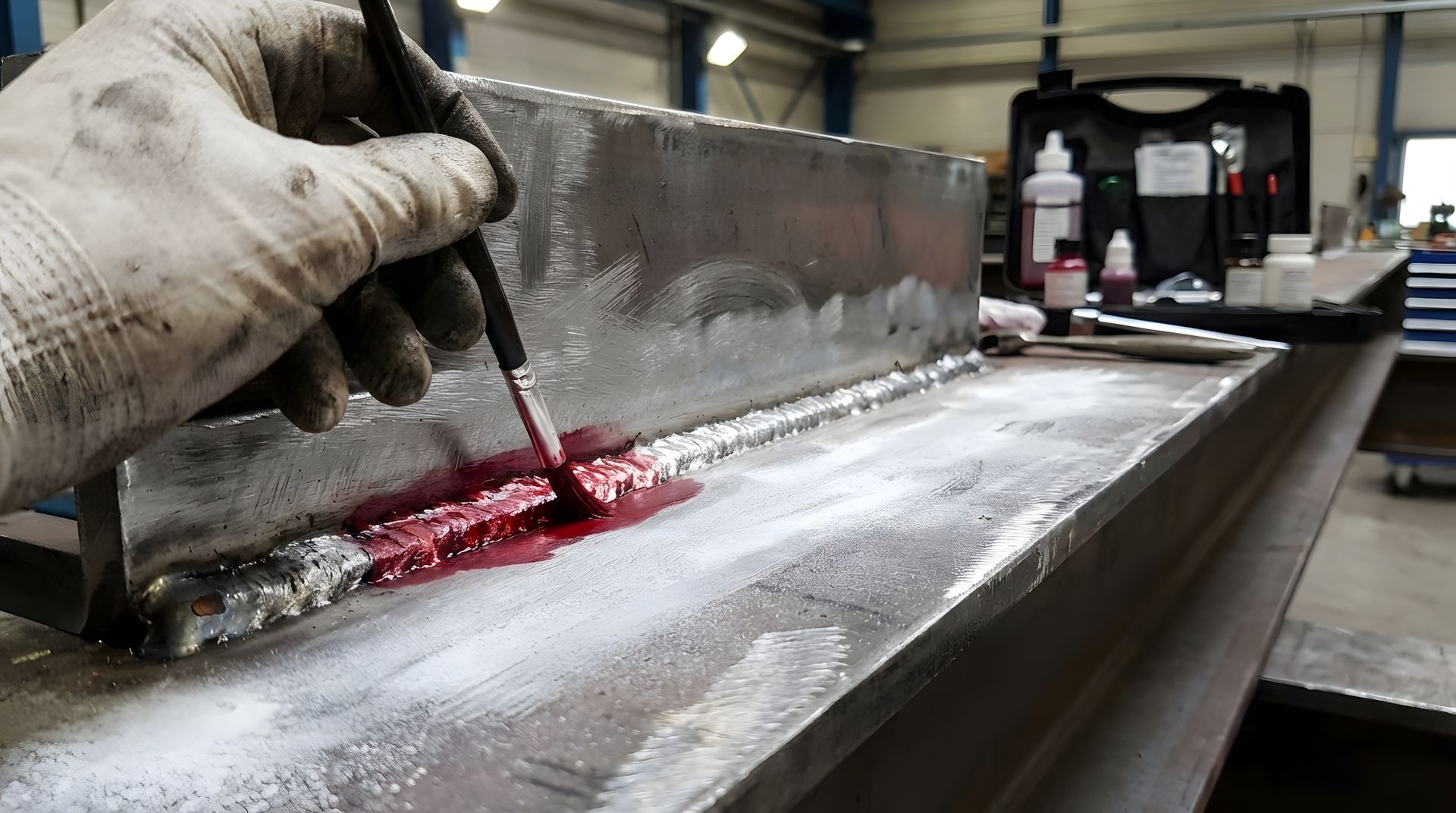
This advanced chemical transformation completely revolutionized the speed and accuracy of penetrant testing across industrial production lines. The new dye-enhanced fluids possessed an incredibly low surface tension, allowing them to seep into microscopic cracks within seconds. When paired with a professional, spray-applied white silica developer, the brilliant red dye bled into the coating to create a high-contrast indication that was impossible to miss. This standardized process allowed inspectors to rapidly verify the surface integrity of structural castings, heavy forgings, multi-pass weldments, and precision-machined industrial parts with absolute repeatability.
The Ultraviolet Revolution: Fluorescent Penetrants and Elite Sensitivity
The single most significant milestone in the evolution of modern surface testing occurred during World War II with the development of fluorescent penetrants. Rather than relying on standard visible dyes under factory lighting, researchers blended highly sensitive fluorescent polymers into the liquid vehicle. When these advanced formulas were exposed to a concentrated ultraviolet (UV) light source in a darkened inspection booth, the trapped penetrant glowed with a brilliant, neon-green intensity.
This technological jump dramatically boosted the sensitivity limits of a standard liquid penetrant testing workflow. The intense contrast generated by fluorescent indicators allowed quality control technicians to locate extremely minute, sub-microscopic surface-breaking cracks that would easily bypass visible red dye checks. Because of this unparalleled precision, fluorescent penetrant systems were quickly adopted as a mandatory quality standard for high-risk manufacturing sectors where component failures were simply not an option.
Aerospace Demands and the Codification of Modern PT Standards
The modern aviation boom of the mid-twentieth century acted as the primary catalyst for turning penetrant testing from a loose shop floor practice into a highly regulated science. The introduction of high-performance jet engines and aluminum airframe architectures forced engineers to manage extreme thermal stresses, intense vibrational fatigue, and tight weight allowances. Under these punishing flight profiles, a microscopic surface scratch could rapidly propagate into a fatal structural failure.
To safeguard flight operations, the aerospace industry pushed for absolute standardization across the NDT landscape. Metallurgists and military agencies co-authored strict operational specifications that defined exact chemical formulations, precise wash methods, and mandatory technician certifications. These historic standards continue to guide modern operations, ensuring that liquid penetrant inspections remain a highly controlled, flawlessly documented, and completely repeatable process.
Why Liquid Penetrant Testing Thrives in the Modern NDT Landscape
In an era dominated by advanced digital infrastructure, computerized radiography, and electromagnetic array technologies, liquid penetrant testing remains an irreplaceable pillar of industrial quality control. The enduring success of this century-old methodology comes down to its elegant operational advantages:
The Operational Advantages of Modern PT
- Absolute Surface Sensitivity: It delivers unmatched precision in locating surface-breaking cracks, cold shuts, and porosity pits across complex shapes.
- Exceptional Material Versatility: It works flawlessly on non-magnetic metals, aluminum alloys, stainless steel, ceramics, and advanced composites where magnetic particle testing cannot operate.
- High Economic Efficiency: It allows for the rapid screening of massive surface areas or high-volume parts runs without demanding expensive electronic calibration.
- Immediate, Actionable Results: It produces a direct, real-time physical map of a defect on the actual surface of the component, allowing for instant weld repairs.
While volumetric methods like ultrasonic testing are vital for mapping internal, subsurface laminations, liquid penetrant testing remains the most efficient, field-proven method for isolating surface vulnerabilities before they can compromise your global asset integrity.
Secure Your Fleet and Infrastructure with Steel City NDT
The long history of surface inspection reveals a fundamental truth: a component's structural reliability is entirely dictated by the health of its surface boundaries. Leaving your welds, castings, and machined components unvetted exposes your business to catastrophic equipment failures, expensive legal liabilities, and unplanned operational shutdowns. Protecting your physical capital requires an inspection firm that pairs deep technical knowledge with field-proven expertise.
At Steel City NDT, we provide elite, code-compliant non-destructive testing solutions designed to keep your business operating safely. Our fully certified, highly experienced technicians deploy advanced liquid penetrant testing and fluorescent penetrant inspection matrices alongside premium ultrasonic testing and visual inspection workflows to capture hidden material defects before they threaten your bottom line. Do not leave your material integrity to chance. Connect with our industrial testing specialists today, explore our full suite of certified non-destructive testing and asset management services, or request a transparent project estimate to secure the definitive standard of operational safety and structural reliability.
What is the fundamental difference between visible dye and fluorescent penetrant testing?
Visible dye penetrant utilizes a bright red fluid that contrasts against a white developer coat under normal factory light, making it ideal for field inspections. Fluorescent testing uses specialized light-reactive polymers viewed under ultraviolet light in a darkened area, delivering exponentially higher sensitivity for microscopic defects.
Can liquid penetrant testing locate defects buried deep inside a structural weld?
No. Liquid penetrant testing is strictly a surface-breaking inspection method. It requires the defect to be open to the atmosphere so the fluid can physically seep into the gap. To locate deep, subsurface volumetric flaws like slag inclusions or internal lack of fusion, technicians must deploy ultrasonic testing.
On which types of industrial materials can you safely execute a liquid penetrant check?
PT can be performed on almost any solid, non-porous material. It is commonly used to inspect stainless steel, aluminum, brass, copper, titanium, and carbon steel. It can also be applied to non-metallic components like dense ceramics, glass, and molded polymers, but it cannot be used on porous materials like wood or unpolished stone.
Why is the cleaning phase considered the most critical step of a penetrant inspection?
Because this method relies entirely on capillary action, the internal cavity of a crack must be completely empty to receive the fluid. If a weld surface is contaminated with grease, carbon soot, rust, or paint, those materials will block the penetrant from entering the flaw, resulting in a dangerous false-safe reading.
How often should critical industrial assets undergo liquid penetrant testing?
Inspection frequencies are strictly mandated by your specific sector codes, structural engineering specs, and local regulatory laws. High-stress assets like pressure vessels, process piping welds, and rotating machinery components typically undergo documented surface checks during annual maintenance turnarounds or after major structural repairs.
You might also like